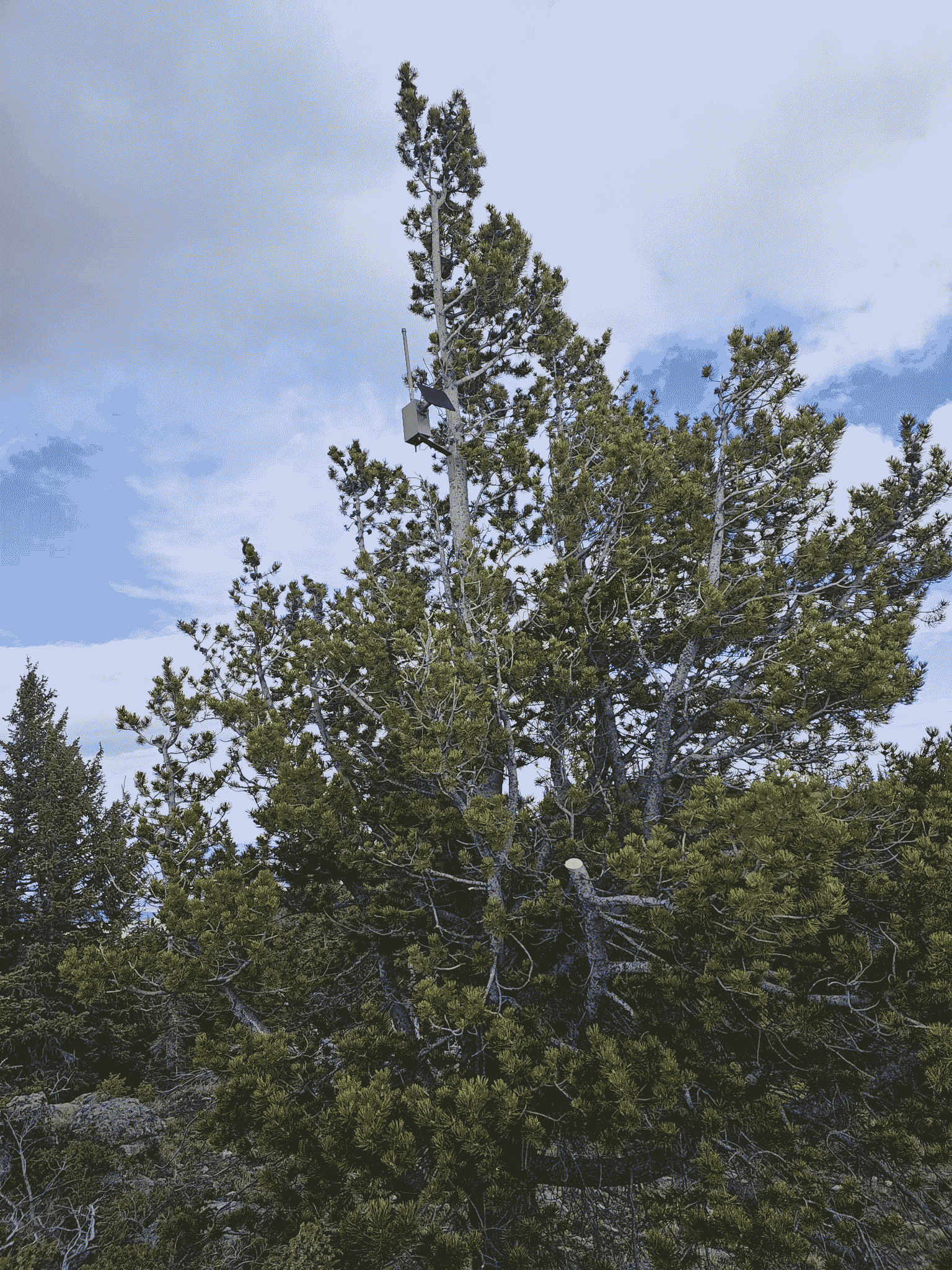
The volunteers who have a goal of providing Meshcore coverage in the mountains of Colorado do not have it easy. We draw upon ham radio experience, and we make use of topographic maps and other tools, to try to figure out where to put a “next repeater” to extend coverage to a new part of Colorado.
Of the several dozen Meshcore repeaters that have thus far been deployed in the mountains of Colorado, fewer than half a dozen have the luxury of “land power” — nearly all rely upon solar power. Maybe you can see the solar panel on the repeater shown at right?
We worry a lot about whether a solar-powered repeater will survive cloudy days. This prompts us to use a big battery and a big solar panel. But it also prompts us to try to monitor the energy production of the solar panel. This blog article describes the results of some of this monitoring for the repeater in the photo above. As you will see, as of press time in November of 2026, it seems we have photons to spare.
The repeater shown above extends Meshcore coverage to an area of about sixty square miles that has no cell service. A person in that area with, say, a broken ankle, could now use Meshcore to call for help.
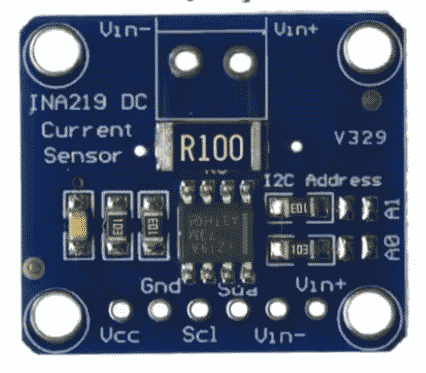
At right you can see the current sensor that is installed in the repeater above. It uses an INA219 chip (spec sheet) with a 100-mΩ shunt resistor, and it uses an I2C bus to report voltage and current from the solar panel.
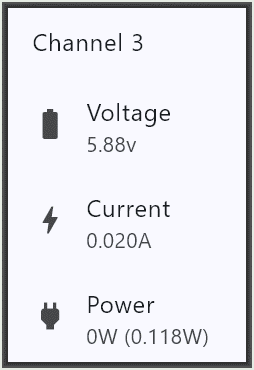
The repeater firmware detects this module on the I2C bus and provides the measured voltage and current to us on a telemetry channel (here, channel 3, seen at right). Just now it is very sunny out, and as you can see the solar panel is producing 5.88V. The solar charging controller (here, the TP4054 controller built into the RAK19007 base board) is choosing to take only a small portion of the available current (here, only 20 mA) because the battery is nearly fully charged. (The solar panel is rated at a nominal 1A, so the controller is using only about one-fiftieth of the likely available current.)
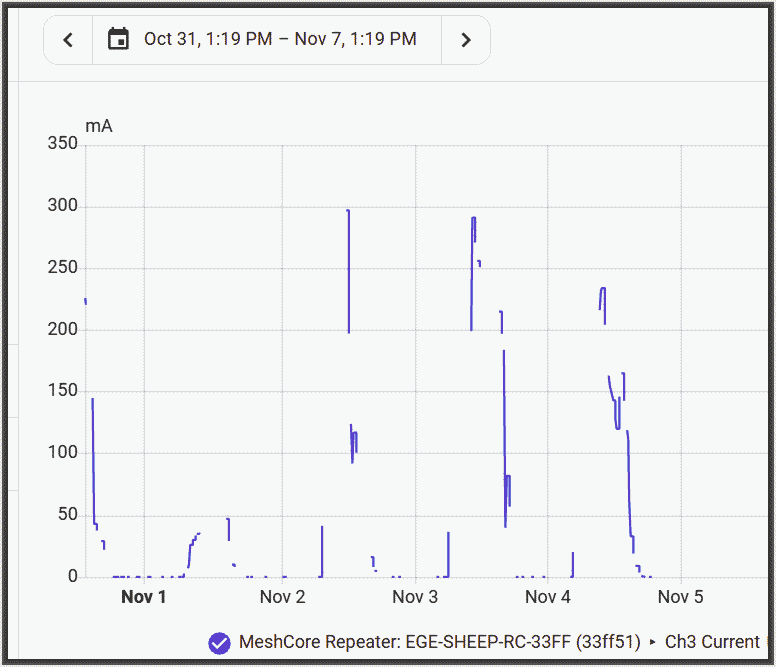
We use Home Assistant to log this telemetry, and at right you can see an example of a log of charging current for the repeater shown above.
I populated some of the logged data into the table below, and I will narrate the row for October 31. Charging for that day started at 10:12 AM, at a time when the battery was at 4.09V. Charging for the day finished at 1:24 PM, at a time when the battery was at 4.17V, so the charging duration was 3:12 (three hours, 12 minutes). But the solar panel continued to offer full voltage until 4:42 PM, which means that it would have been possible to do charging for as long as 6 hours, 30 minutes. This means the “photons to spare” ratio was about 2:1.
On three later dates, the “photons to spare” ratio turned out to be 2.1:1, 1.2:1, and 1.5:1.
| date | low batt voltage |
charging begins |
high batt voltage |
charging finishes |
actual charging duration |
panel went to low voltage |
charging duration could have been |
extra factor |
| 10/31/26 | 4.09 | 10:12 AM | 4.17 | 01:24 PM | 03:12 | 04:42 PM | 06:30 | 2.0 |
| 11/02/26 | 4.06 | 07:10 AM | 4.14 | 11:30 AM | 04:20 | 04:26 PM | 09:16 | 2.1 |
| 11/03/26 | 4.07 | 10:21 AM | 4.17 | 04:02 PM | 05:41 | 05:04 PM | 06:43 | 1.2 |
| 11/04/26 | 4.11 | 09:22 AM | 4.16 | 01:48 PM | 04:26 | 03:50 PM | 06:28 | 1.5 |
This bigger-than-one ratio is of course good news, and it means that we may have achieved our goal of sizing the solar panel to be bigger than what is minimally needed.
Another scaling factor is the battery size. Here we provided a 10-Ah lithium-ion cell and the repeater averages a current draw of around 14 mA. If we could assume that the cell would deliver its full capacity (which we cannot, because it will get quite cold in coming months), then we might see twenty or more days of service even with no sunlight at all. To say this differently, we have intentionally over-engineered the capacity of the cell in the hopes that even when it is quite cold, there might still be enough energy available from the cell to get through at least a few cloudy days. For now, the energy drawn during the night only pulled the cell down to around 4.06V.
Winter is coming, and the sun will be lower in the sky and maybe the days will be more cloudy. And the cell will get much colder. We will watch this repeater closely to see how it performs through the winter.
Leave a Reply