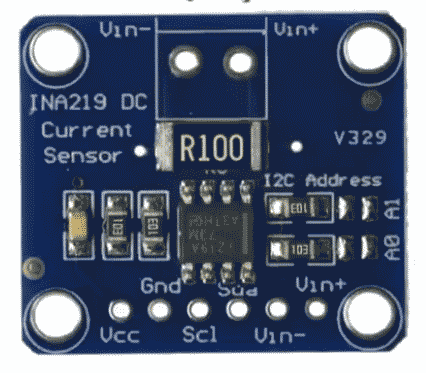
In the Public channel for the Colorado meshcore community, a participant recently mentioned experimenting with a sodium-ion cell as the energy storage for a solar powered repeater. I invited the participant to share any results of the experiments. The participant then said “I will try. Would be a whole lot easier if it was actually possible to get telemetry from remote nodes.” This article talks about how to get telemetry from a remote node, for example using the current sensor seen at right.
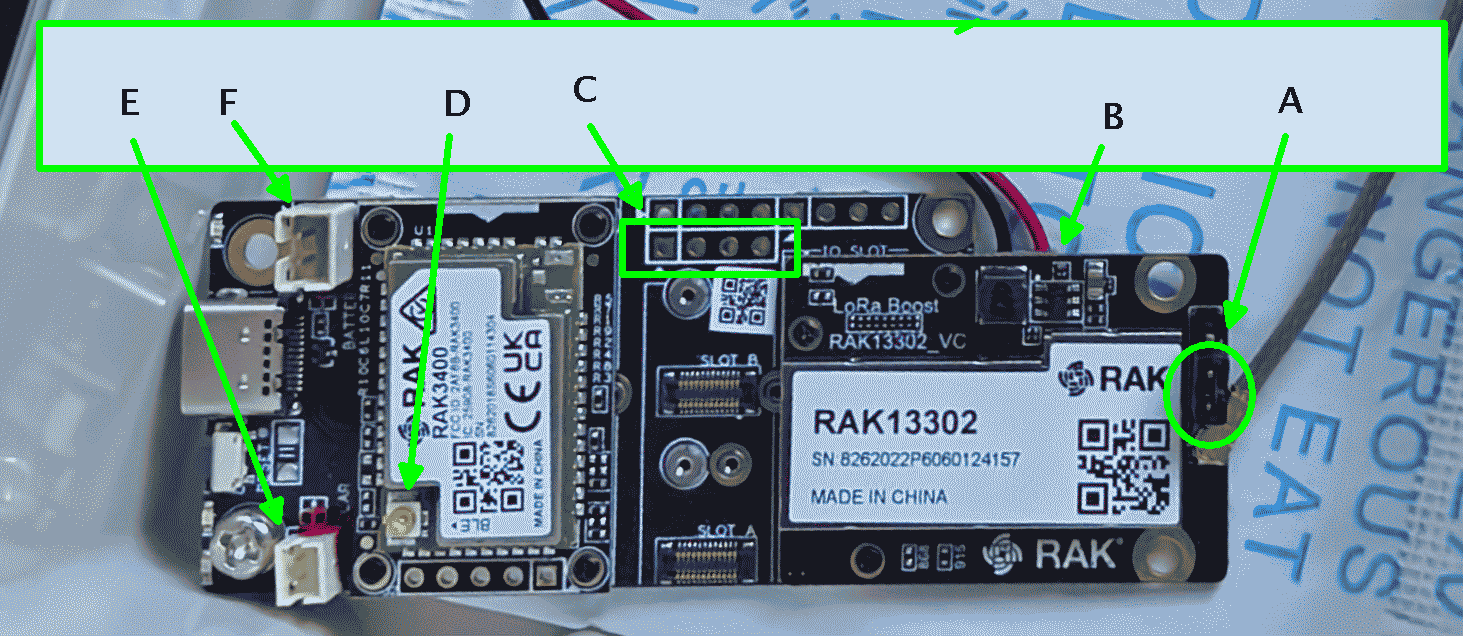
A key first step is to gain familiarity with the I2C bus that is provided by many LoRa microcontrollers. The radio at right uses the RAK 19007 baseboard, which provides the I2C bus at C.
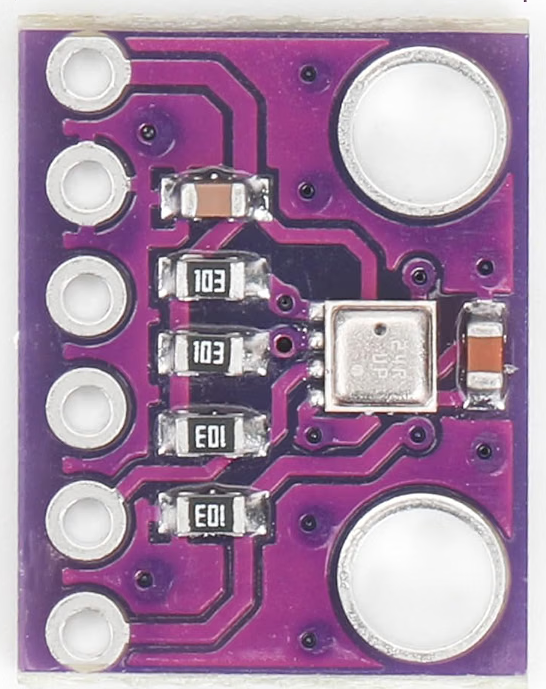
We then connect this I2C bus from the radio base board to the INA219 current sensor shown above, and to the BME280 environmental sensor shown at right. This BME280 sensor lets us monitor the humidity within the weatherproof enclosure of the repeater. (This humidity information hopefully gives us early warning if water has leaked in.)
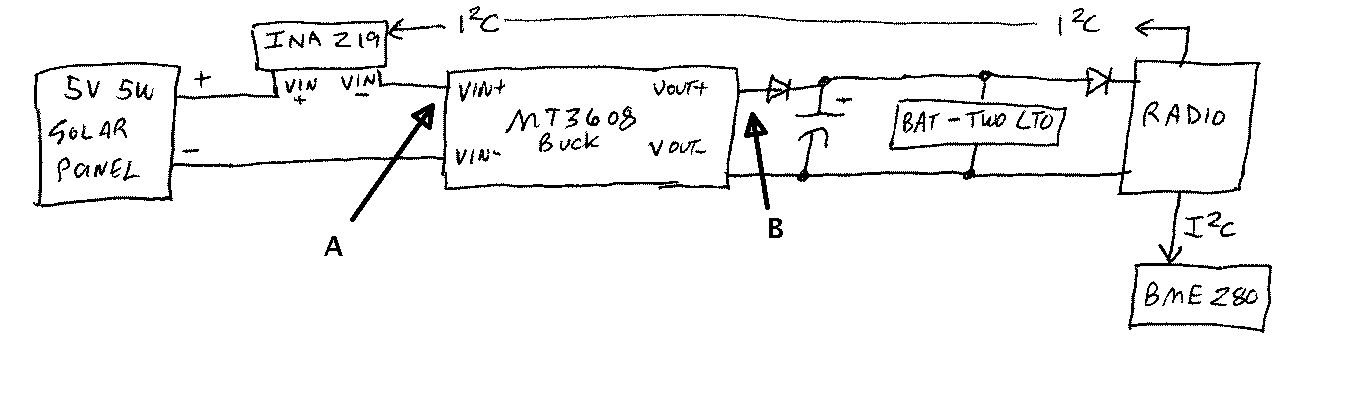
The result is the block diagram shown at right. The current from the solar panel passes through the current sensor on its way to the rest of the repeater.
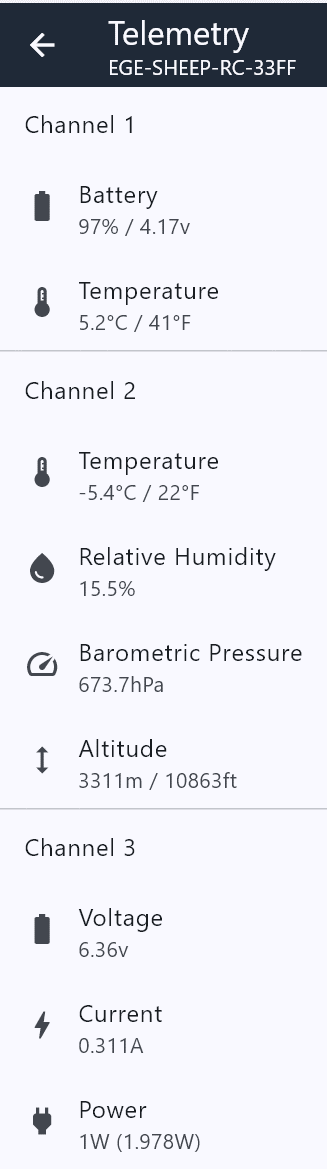
At right you can see three channels of telemetry from a repeater that we deployed near the Green Mountain reservoir in Summit County, using the sensor approach described above. Telemetry channel 1 is from the microcontroller itself (an nRF52 device). The microcontroller uses an A/D converter to measure the battery voltage (here, 4.17V) and the core temperature of the microcontroller (here, 41° F). Channel 2 is from the above-mentioned BME280 sensor, providing the true temperature inside the repeater enclosure (here, 22° F) and the relative humidity inside the enclosure (here, 15.5%). It also tells us the approximate elevation of the repeater (here, around 10863 feet). Channel 3 tells us the voltage developed by the solar panel (here, 6.36V) and the charging current (here, 311 mA). This works out to around two watts being fed to charge the cell (here, a 10 Ah lithium-polymer cell).
The radio itself draws around 14 mA when receiving. When it transmits, it draws around one ampere. In recent times, this repeater has been transmitting about 1.7% of the time.
We use Home Assistant with a Meshcore integration to log telemetry from our repeaters.
Leave a Reply