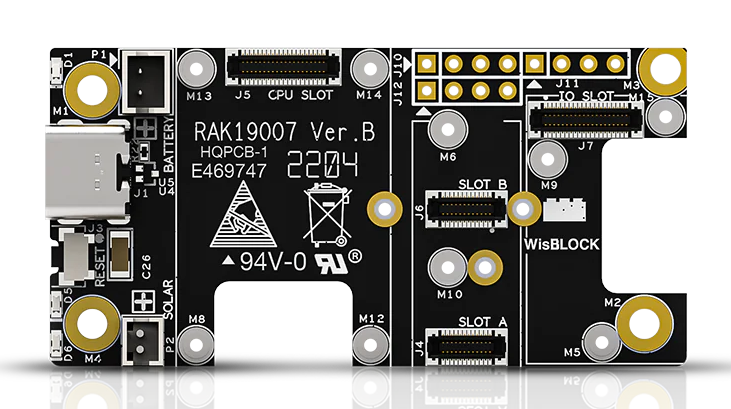
The usual path for the Harbor Breeze repeater hack is to use the charge manager that comes with the HB light. In this article I construct an HB repeater that uses the more sophisticated charge manager that is provided in the RAK 19003 and 19007 baseboards. This offers an opportunity to charge the battery at around 200 mA instead of the 50-80 mA that the HB charge controller would provide.
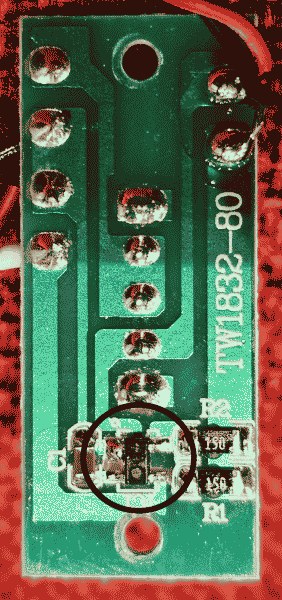
At right you can see the charging controller chip (circled in black) that comes with the HB lawn light. The chip is a four-pin (update: five-pin) chip and it is impossible to find documentation for the chip. I have found this chip to provide 50-80 mA of charging current.
For many of my DIY repeaters I have used the RAK Wisblock ecosystem as described in this blog article. This ecosystem uses your choice of the RAK 19003 “mini” baseboard or the RAK 19007 larger baseboard. Regardless of which baseboard you pick, you get a more sophisticated charging controller chip as descibed in my earlier blog article. It is a TP4054 controller (spec sheet). For today’s project I used most of the bill of materials from that earlier article, including the antenna and mounting brackets.
The baseboard has a 2.7KΩ programming resistor, thus limiting charging to around 297 mA. I have measured actual charging currents at 141 mA and at around 200 mA. To comply with the “0.05C rule” this might call for a battery with a capacity of 2820 mAh or even 4000 mAh. I decided to take a chance and I selected a 3500 mAh battery for this project, gambling that maybe I won’t destroy the battery due to charging at below-freezing temperatures.
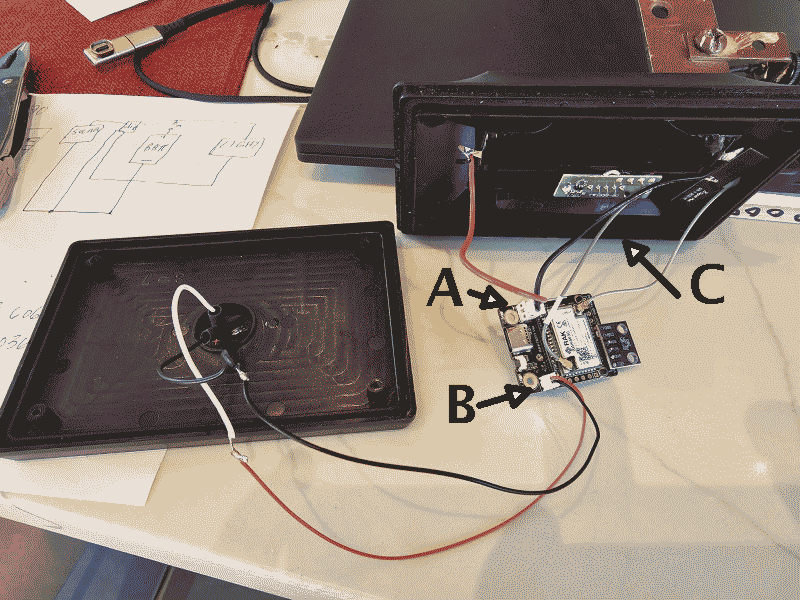
The RAK baseboard provides two power connectors. The connector A receives a cable with a PH 2.0 female connector, and is meant to connect to a lithium-ion battery. (Note that the connector is wired “backwards” compared with what any normal cabling would use.) Here I have wired it to the HB battery holder.
The connector B receives a cable with a PH 1.5 female connector, and is meant to connect to a 5-volt solar panel. The HB solar panel is 5V and so is ideal for this function.
At C you see the HB charging controller which I disconnected from everything else. I left it in place simply to preserve the watertight filler for the switch on the bottom of the enclosure.
It will be appreciated that this setup leaves the radio “always on”. I think this is better than having an external on-off switch, since such a switch presents the risk of accidentally turning the switch off.
At some point I expect I will receive the one-watt RAK kits (see article) that I ordered from RAK a week ago. When the one-watt kits arrive, I will probably adapt today’s design for those kits.
Leave a Reply