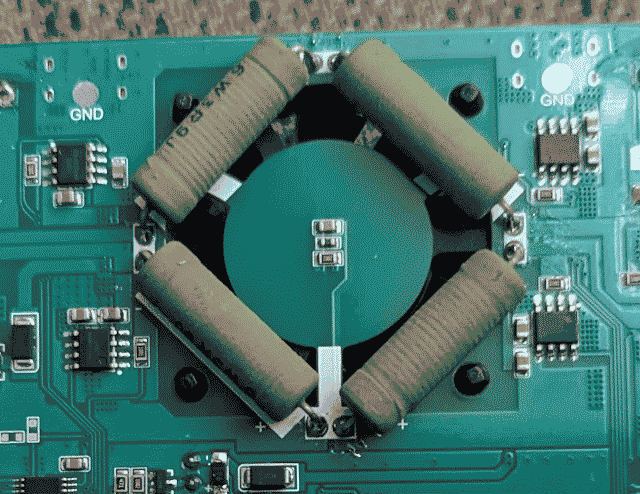
Loyal readers know (blog article) that recently I obtained a device that can carry out capacity testing on as many as four lithium batteries at a time. How exactly does the device measure the capacity of the battery? How does the device dissipate the heat during this testing? This blog article discusses and answers this question.
As a reminder, this very handy tester can carry out any of three functions:
- charging a battery up to 4.2 volts;
- discharging a battery down to a predetermined voltage while logging the voltage and current, thus measuring the charge capacity and energy capacity of the battery; and
- carrying out a three-step (“auto”) cycle of charge and discharge and charge.
The “auto” cycle can be programmed to run just once or can be programmed to run as many as six times in sequence.
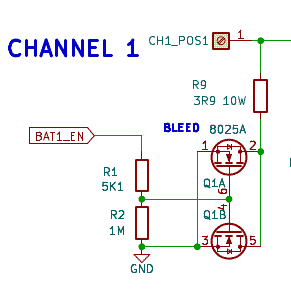
How does the tester carry out the discharge of the battery? Part of the answer may be seen in the schematic at right — when control line BAT_EN is enabled (turning on the MOSFET), then a 3.9Ω resistive load is placed across the battery.
(From the photograph, you can see that each load resistor is a wire-wound resistor, which means that it has some inductance. In this application, the current is DC, so we do not care about the inductance.)
If recently charged up all the way, the battery might be at 4.2V in which case the current would be just over 1A and the power dissipated in the resistor would be around 4½W. (The series MOSFET imposes a nearly negligible voltage drop in this circuit, so the current can be reasonably modeled while ignoring the MOSFET. Of course if there were an undesirable level of internal resistance in the battery, this would greatly reduce the load current.)
This 4½W load is well within the 10W rating of the resistor, but the designers of this tester nonetheless provide a cooling fan that blows air across all four resistors (each of which provides a discharge load for one of the four battery testing channels).
During the discharge process, the battery might run down to (for example) 2.8V. At this point the current might be around 720 mA in which case the power dissipated at this point would be as low as around 2W.
During the discharge process, as mentioned above the tester logs the voltage and current for as many as all four of the battery channels. The tester integrates the current to arrive at a measure of the charge capacity of the battery (measured in mAh). The tester also integrates the product of the voltage and current (namely the power) to arrive at a measure of the energy capacity of the battery (measured in mWh).
The fun part is to realize that the designers provided the cooling fan to cool the four load resistors.
Leave a Reply