How good are Harbor Breeze batteries?
In a previous blog article I posted my findings on the quality of the batteries that Seeed uses in its SenseCAP Solar Node P1-Pro solar repeater nodes, namely that their actual measured capacity turns out to be better than the claimed capacity that is written on the batteries and that is described in the Seeed shopping cart.
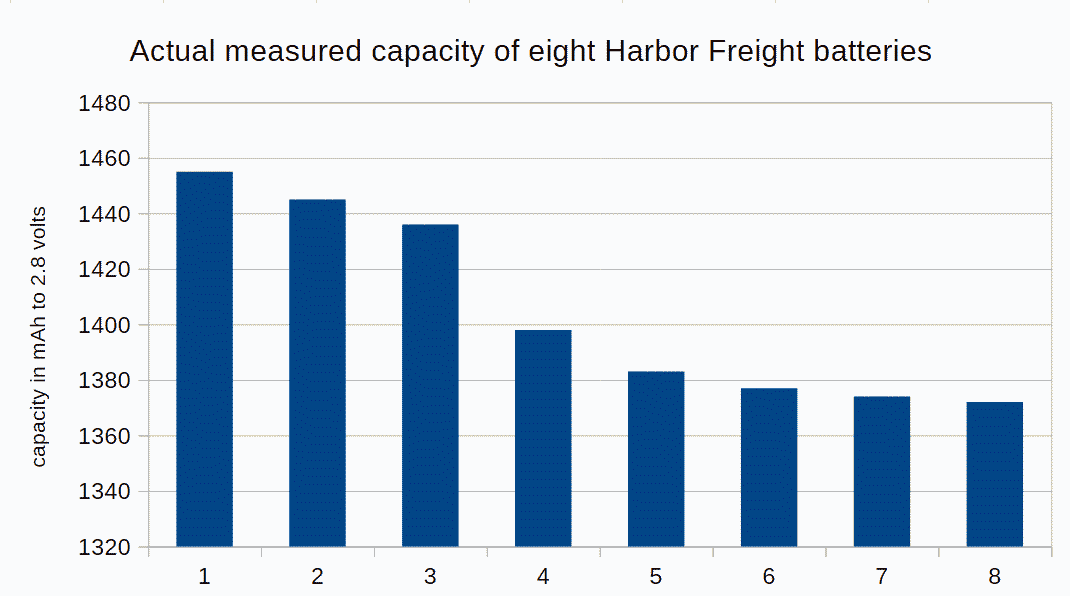
I have now had an opportunity to test actual measured capacity of eleven Harbor Breeze batteries. (I did this by running each battery from “fully charged” down to 2.8V.) The markings on the batteries claim a capacity of 1500 mAh and 5.55 Wh. You can see the bar graph above which gives my actual test results for eight batteries that did not fail prematurely.
As you can see, not one of the eight batteries actually provided the claimed capacity of 1500 mAh. Every battery fell short. The shortage was anywhere from 3% to as much as 8.5%.
Having said this, I need to acknowledge that Lowes does not actually publish to the retail customer any claim about the capacity of the battery in its sixty-lumen lawn light. To see this “1500” number one must disassemble the product to see the battery that is inside the product.
Not only that, one must consider that the price is right. The whole point of the Harbor Breeze solar repeater hack (using RAK controllers or Seeed controllers) is that for a mere $10, one gets a solar panel, a battery, a charging controller, and a weathertight gasketed housing. Any repeater that uses an nRF52 controller is only drawing an average of a mere 12-15 milliamperes. The battery, whether at 1372 or 1455 or 1500 mAh, is providing several days of service even in the face of no sunlight at all reaching the solar panel.
Sadly, five out of the eighteen Harbor Breeze batteries that I have worked with in recent months have failed prematurely. This serves as a reminder that a person ought to do a charge-cycle test on any battery once or twice before placing it into service in a repeater. This is especially so for a repeater that will be deployed to a site that is not easy to get to or that is crucial to the function of the Meshcore network.
The fact that the average Harbor Breeze battery falls a bit short of its claimed capacity is not a big problem. It is just interesting to see how eight batteries tested out. (And it is sad that five out of eighteen HB batteries failed prematurely.)
By now, having accumulated the experience of a few months operating Meshcore repeaters, my general approach has gotten to be like this:
- For sites that are crucial to network function, and that not easy to get to, don’t use Harbor Breeze repeaters at all. Use Seeed SensCAP solar node P1-Pro repeaters.
- The best place to put HB repeaters is … places that are easy to get to, and that are perhaps not quite as crucial to the function of the network.
Leave a Reply