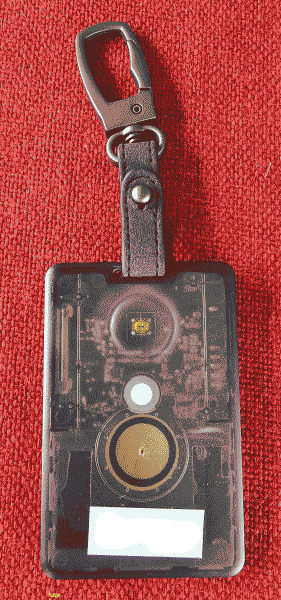
LoRa mesh (for example Meshtastic and Meshcore) is ideal for tracking a pet. At right you can see a credit-card-sized tag that could be clipped to the collar of a pet. It contains a GNSS (GPS) receiver and a LoRa transmitter. Using LoRa mesh, it will constantly update the pet’s owner as to the exact location of the pet.
Most commercial pet tracker solutions are a disappointment. Most tracker solutions depend on cell service, meaning that if the pet strays into an area of poor cell coverage, they are of no help finding the pet. Not only that but a tracker that depends on cell service necessarily has a recurring cost.
A tracker solution that does not depend on cell service might depend on a bluetooth or wifi connection. Bluetooth only reaches around 30 feet (ten meters). A wifi connection only reaches perhaps a hundred feet (3o meters).
With LoRa mesh, any two devices that have a line of sight between them can be a mile apart and can still communicate. They might be two miles apart and still communicate. They might be six miles apart and still communicate.
A LoRa mesh approach to tracking a pet has a monthly cost of … wait for it … zero.
But one of the very interesting things about LoRa mesh is that even if two devices happen not to be within line of sign, they might still communicate, because some other mesh device might happen to be located in a place that permits forwarding data packets between the two devices. This might be a mesh device carried by a hiker. This might, amazingly, be a mesh pet tracking tag on somebody else’s pet. Or this might be a mesh solar node that was installed by a benevolent homeowner.
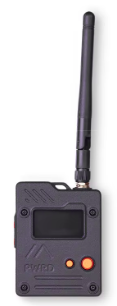
How does this work exactly? To track a pet using LoRa mesh, a typical way to proceed would be to get a SenseCAP Card Tracker T1000-E (seen above) and a device such as a Wio Tracker L1 Pro (seen at right). The devices can be configured to send encrypted messages back and forth. The messages would include the exact position of the tracker tag, determined with a GNSS (GPS) receiver in the tracker tag. If the pet were to happen to be within line of sight of the owner, the two devices would be communicating directly. Otherwise the two devices would communicate with the help of other mesh devices, such as (for example) one or more solar nodes provided by nearby homeowners.
Each device runs on a rechargeable battery. The battery life of the tracker card that is clipped to the pet’s collar is likely to be 1-2 days. (It would thus need to be recharged pretty often, perhaps once per day.) The battery life of the handheld tracker might be 4-5 days.
For a new user of LoRa mesh devices, there are a few things to learn to get the devices working. It is likely that volunteers would be available to help a new user with this.
The tag that is clipped to the pet is IP65 rated, meaning it can get rained on with no problem. The tag weighs a mere 32 grams (just over one ounce), with dimensions 85 x 55 x 6.5 mm (about 3½ x 2¼ x ¼ inches).
The tag has a temperature sensor and a sensor that measures ambient light (in units of lux). The pet owner can see the temperature and light level at the pet’s location.
What does it cost? The SenseCAP Card Tracker T1000-E costs $51 on Amazon, but its maker (Seeed) offers it at $40. The Wio Tracker L1 Pro costs $60 on Amazon or $47 on the Seed manufacturer’s web site.

Leave a Reply