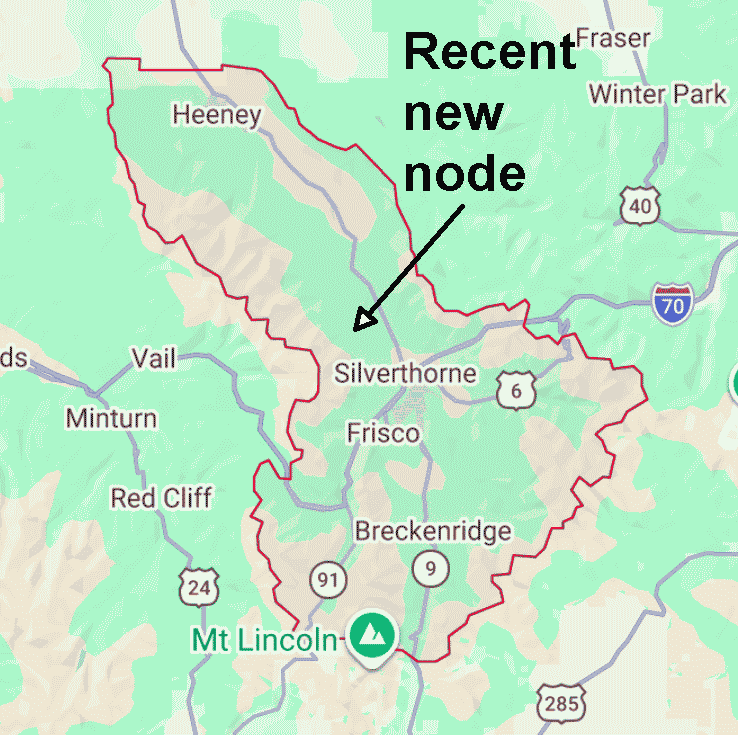
(Update: a new node has been installed in the Ptarmigan neighborhood area.)
With the addition of just two or three nodes in helpful locations, it will be within reach to provide very good LoRa mesh coverage in Summit County, Colorado. You might wonder “What is LoRa mesh and why do I care?”, and you might next wonder “How can I help?” This article explores these questions.
(There are two popular communities for LoRa mesh, namely Meshtastic and Meshcore.)
What is LoRa mesh and why do I care? I discuss this topic in this blog article.
LoRa mesh might help you or your neighbor find a lost dog.
LoRa mesh might help a hiker get in touch with another member of his or her hiking party.
LoRa mesh provides reliable communications even during a cell service failure.
During a disaster or emergency such as a wildfire, cell tower resources get prioritized to emergency responders and government agencies, leaving only a portion of the cell tower resources for ordinary customers. This often leaves many cell phone users unable to place telephone calls or to send text messages. During such times, LoRa mesh allows people to have reliable communications with family and neighbors.
How can I help? There are at least two ways that you can help with improvement of LoRa mesh service in Summit County. These include:
- installing a solar node at your location, and
- obtaining one or a few handheld LoRa mesh devices and leaving them turned on sometimes.
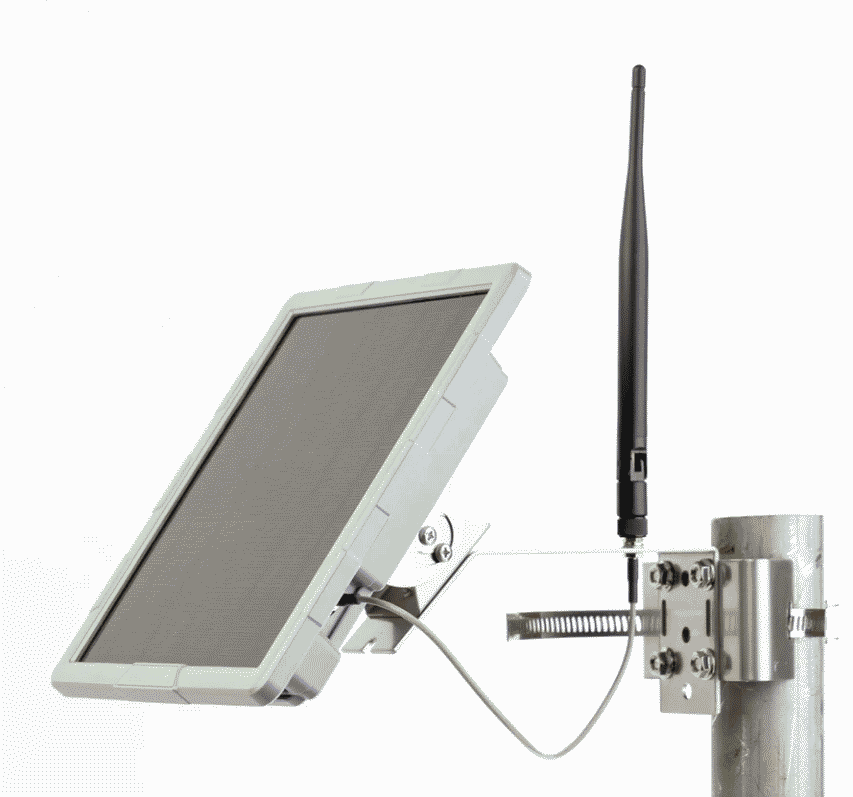 Installing a solar node at your location. The biggest and most impactful way that you can help is by installing a solar node at your location. Related to this is the notion of allowing a volunteer to install a solar node at your location.
At right you can see an example of a solar node. This device is the size of a computer tablet. It does not need any electrical power because it is solar powered. It does not rely on any connection to a cell tower. It does not need any Internet connection, so it does not need wifi to be available. It is basically an “install it and forget it” kind of thing.
A typical location for a solar node is on a high point of a building, on a south or west or east face of the house. (Being solar powered, it needs to be able to pick up sunlight.) Ideally the antenna (the black thing sticking up in the photograph) will have an unobstructed view in several directions.
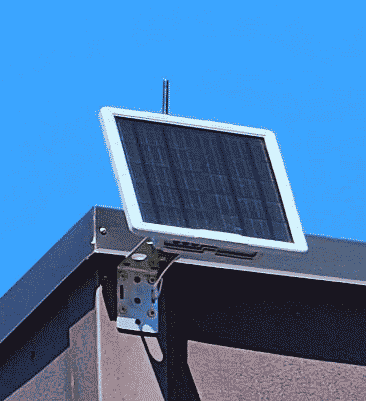
At right you can see a solar node that I installed recently on a home in Ruby Ranch near Silverthorne. It required no electrical wiring. It was simply a matter of selecting a place to put the node (in this case, a chimney), and then screwing a few screws through holes in the mounting bracket, into the chimney.
(If you make use of a Meshtastic device, you can “see” this node. It is a Meshtastic device and its name is “ruby solar”.)
The node makes no sound. It does nothing all day, other than receive LoRa data packets from time to time, forwarding the data packets as needed to help each data packet reach its intended destination.
If the node were to have a motto, it would be “give kindness to strangers”. The node might forward a data packet that helps a dog owner find a lost dog. The node might forward a data packet that helps a hiker get in touch with another member of his or her hiking party.
Of course we hope there would never be a wildfire in Summit County. But if there were, the node would almost certainly make a world of difference for family members and neighbors trying to get in touch with each other.
What does a solar node cost? The The SenseCAP Solar Node P1 Pro shown in the photograph sells for $140 on Amazon, $79 on Aliexpress, and $70 on Seeed’s own shopping cart. If you were to purchase such a node, there are volunteers who would be glad to help you get it set up, and who would be glad to help you pick a place to install it, and who would be glad to help install it.
If cost were a concern, it is likely that a volunteer would be willing to provide a solar node free of charge to the generous homeowner.
What are the drawbacks to installing a LoRa solar node? It’s not easy to think of drawbacks. It does not use your electricity or wifi. It does not interact in any way with any electronic device in your home.
What are the potential benefits to installing a LoRa solar node? The benefits are, perhaps, intangible. There is the thought that even without knowing it, you may have helped a dog owner find his or her dog. Without knowing it, you may have helped a member of a hiking party get in touch with another member of his or her hiking party.
And, were there ever to be a disaster such as a wildfire in Summit County, there is no doubt that you would help people in Summit County get in touch with their family members and neighbors.
Obtaining one or a few handheld LoRa mesh devices and leaving them turned on sometimes. Yes, the way that LoRa mesh works, any person who obtains and uses even a single LoRa mesh device will, perhaps without being aware of it, be helping other people communicate with each other. Each LoRa mesh device has the potential to forward data packets between other LoRa mesh devices.
So if you obtain and use even a single LoRa mesh device, and leave it turned on sometimes, you are likely to be providing kindness to strangers in this way.
Leave a Reply