The Summit County Meshcore activity had its start very recently, in around March of 2026. This means that until now we have never been through a winter. Our Summit County Meshcore volunteers tend to construct our own repeaters rather than using off-the-shelf commercially available repeaters. A chief reason for this is that nearly all of the off-the-shelf repeaters use conventional lithium-ion cells. We lack confidence, however, that lithium-ion chemistry will work well in frigid winter mountain-top temperatures. This has prompted us to do two things that are probably quite different from what most Meshcore volunteers do:
- we add extra circuitry to each repeater so that we can closely monitor the power produced by the solar panel, and
- we use LTO (lithium-titanate-oxide) cells instead of the commonly used lithium-ion cells.
From our perspective, it is a really big problem that nearly all of the off-the-shelf repeaters are designed for lithium-ion chemistry. There are dozens of inexpensive chip solutions for lithium-ion charging and for charging lithium-ion cells from solar panels, and those solutions are worse than useless for LTO chemistry, for many reasons:
- battery management chips for ordinary lithium-ion cells tend to cut off the load when the cell’s output drops below around 2.8 volts, and an LTO cell only ever reaches around 2.4 volts; and
- battery management chips for ordinary lithium-ion cells tend to try to keep charging up to around 4.2 volts, but if you apply more than about 2.8 volts to an LTO cell, you will destroy it.
You then need to decide how many cells to put into your LTO battery — one cell? Two cells? If you pick one cell, you will only ever develop maybe 2.4 volts. This will be inadequate to power a 3.3-volt or 5-volt radio, so you would need a buck converter to convert the 2.4 volts to some higher voltage to power the radio. We have tended to use two cells, meaning the LTO battery is at around 4.8 volts when fully charged.
The cells we have been using have a capacity of around 1500 mAh each. Each 2.4-volt cell thus offers a capacity of perhaps 3½ watt-hours. The two-cell battery thus offers perhaps 7 watt-hours. The quiescent power consumption of the typical LoRa radio (using an nRF52 processor) is perhaps 80 mW, and so we might guess that with no sunlight at all, the battery might last three days or more.
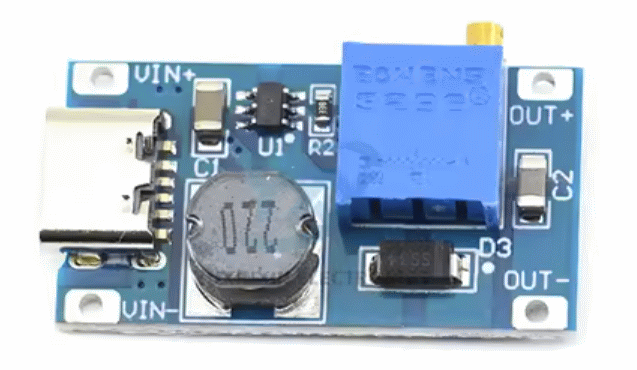
The decision to use a two-cell battery means we need to develop around 5.6 volts to charge it. This is all fine and good except that no off-the-shelf Meshcore repeater is able to provide a 5.6-volt charging voltage. (They generate a mere 4.2 volts of charging voltage.) Indeed an ordinary inexpensive solar panel will only provide 5 volts or so in full daylight, and will often provide only 2-4 volts when it is cloudy. So we need to provide a buck converter that can receive any of the wide ranges of voltage that a 5-volt solar panel might generate and can convert it to the 5.6 volts needed to charge a two-cell LTO battery. At right you can see the popular MT3608 buck converter t(MT3608 data sheet) that we have been using for this purpose.
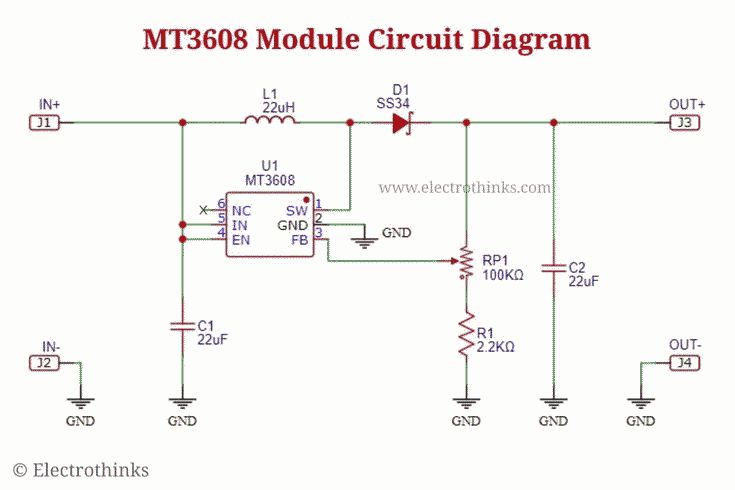
The buck converter can receive anywhere between around 2 and 24 volts and can be set (via its blue potentiometer) to generate any particular voltage in a range of 5-28 volts. The MT3608 switches at 1.2 MHz and works at better than 90% efficiency. At right you can see the schematic for this buck converter. We adjust it to generate around 5.5 volts which is high enough to charge a two-cell LTO battery and is not too high for the battery-power input of the RAK one-watt mesh radio.
Having said all of this, we face the prospect that Winter Is Coming and that the temperature on a mountaintop might be minus 40 degrees. (The alert reader already knows that this is the same in Fahrenheit or Celsius degrees.) This makes our volunteers much more interested than many in warmer climates might be, in watching closely to see how the solar battery charging process works out.
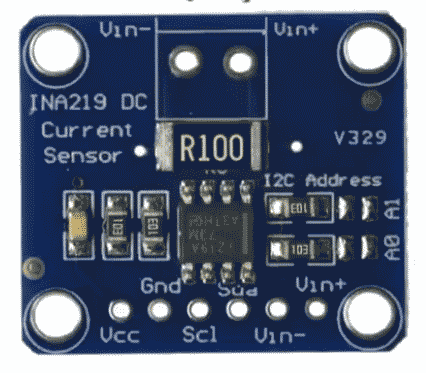
We monitor solar production using an INA219 current measurement device (seen at right) which uses the popular INA219 chip (spec sheet).
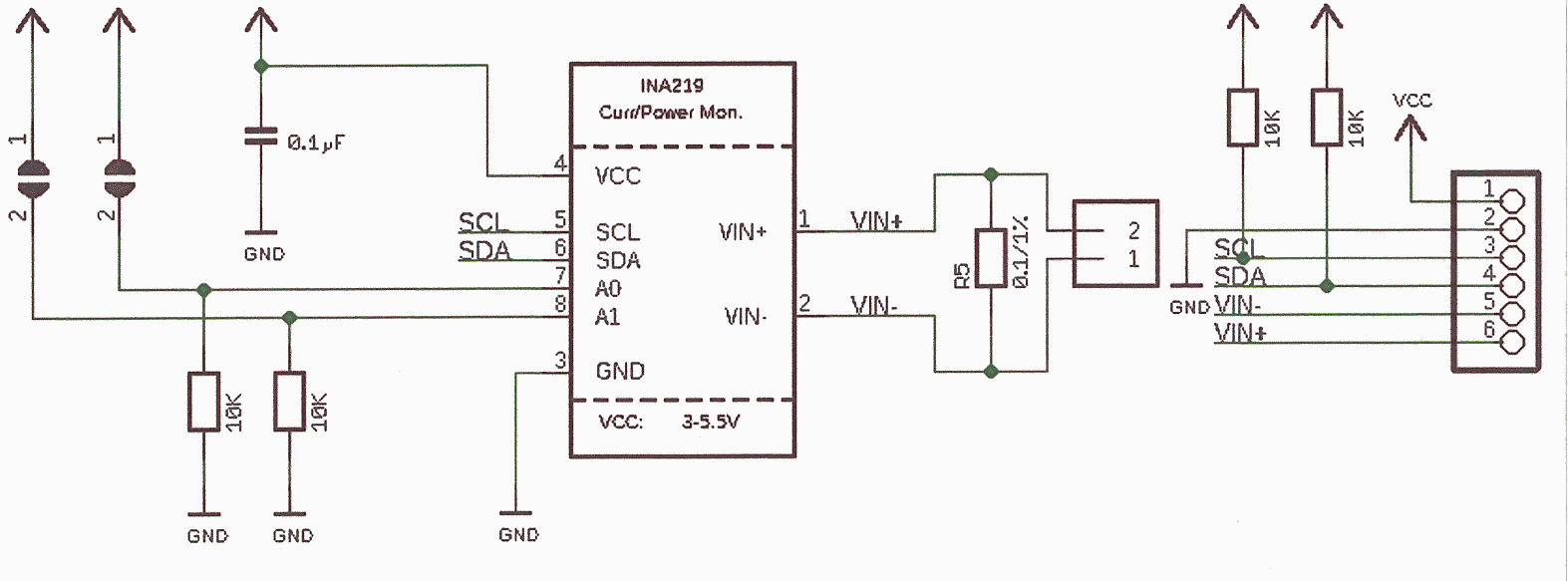
At right you can see the schematic for this device. It is an I2C device and so makes its information available to the microcontroller of the repeater as an ordinary telemetry channel. (We also usually provide a BME280 sensor for temperature, humidity and barometric pressure, and it is also an I2C device and so likewise makes its information available to the microcontroller of the repeater as an ordinary telemetry channel.)
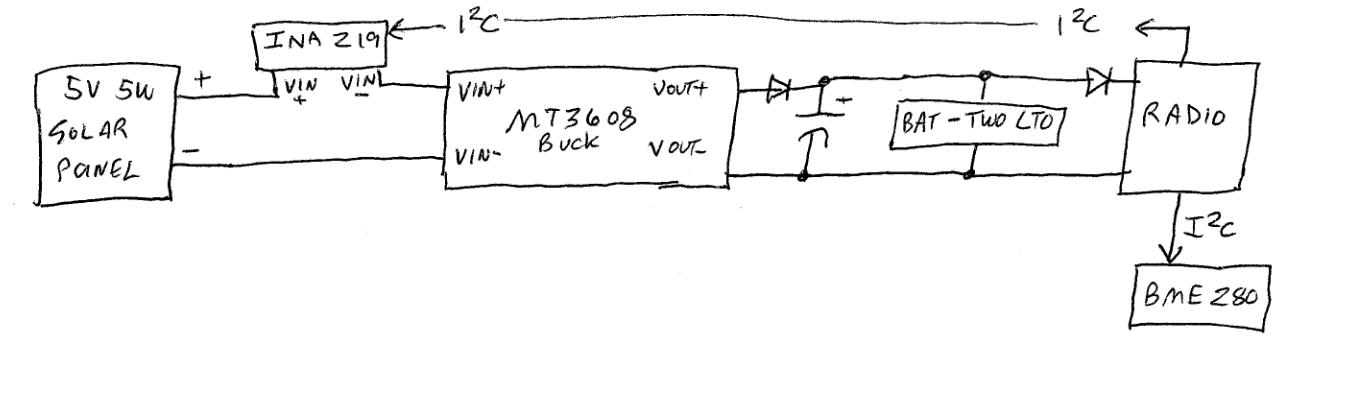
A typical finished repeater has a block diagram like what you see at right. Solar production from a five-watt five-volt solar panel passes through the VIN+ and VIN- terminals of the INA219 device and is then fed to the input terminals of the MT3608 buck converter. The converter provides its charging current through a diode to charge the LTO battery. The battery provides power to the LoRa mesh radio.
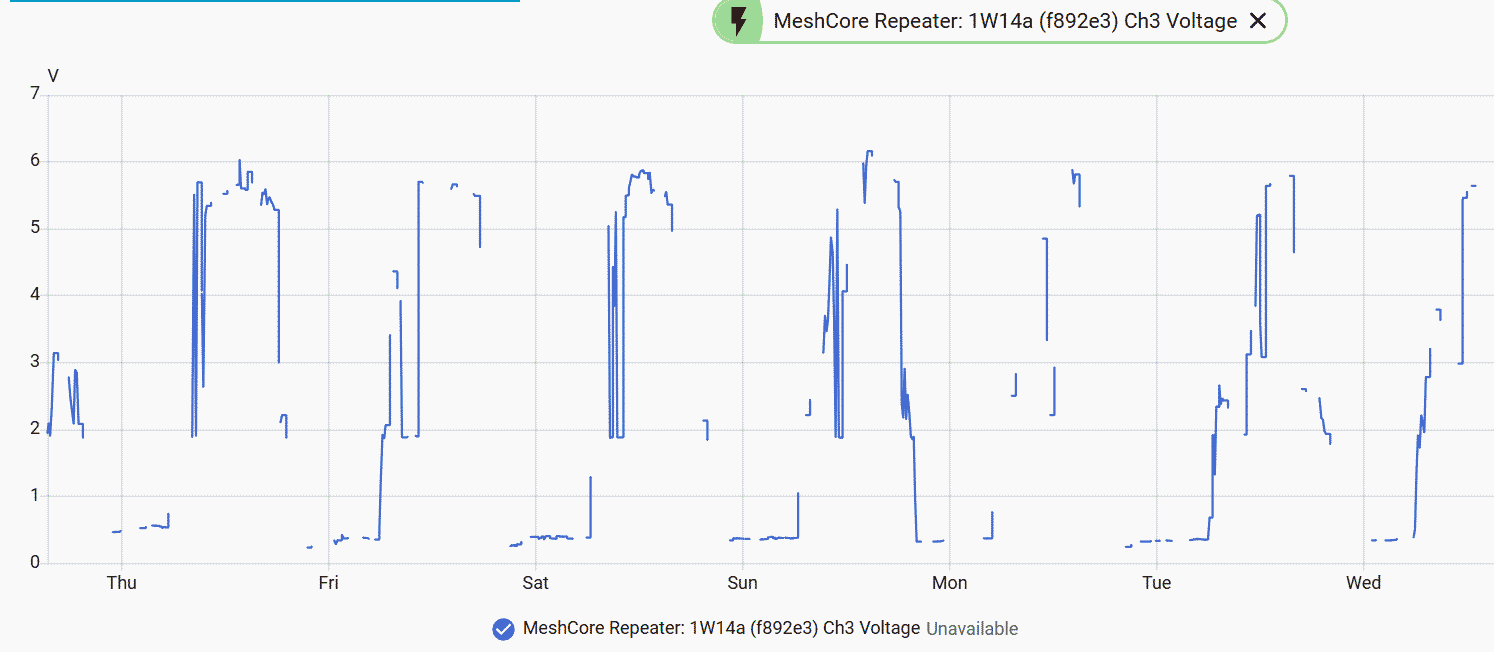
Before placing any newly constructed repeater into production service, we watch while it passes through several days of charge and discharge. At right you can see the output voltage from the solar panel in one of our Meshcore repeaters over a seven-day period. During the day its output is between 5 and 6 volts. At night the voltage drops to near zero.
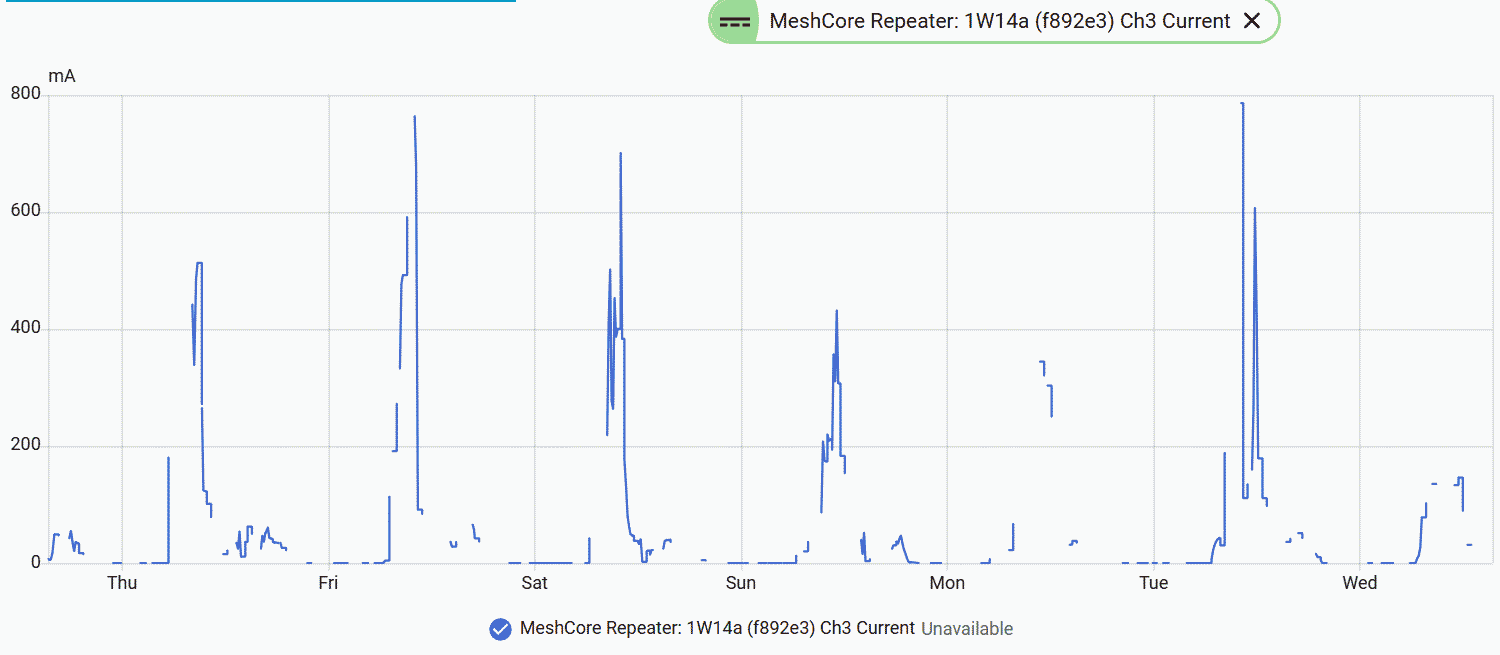
At right we see the current from the solar panel during this same seven-day period. During the night the current is around zero, and each morning it rises to some maximum that might be 300 mA or 800 mA. This persists for an hour or two until the LTO battery is fully charged. For the rest of the daytime the current is back to near zero.
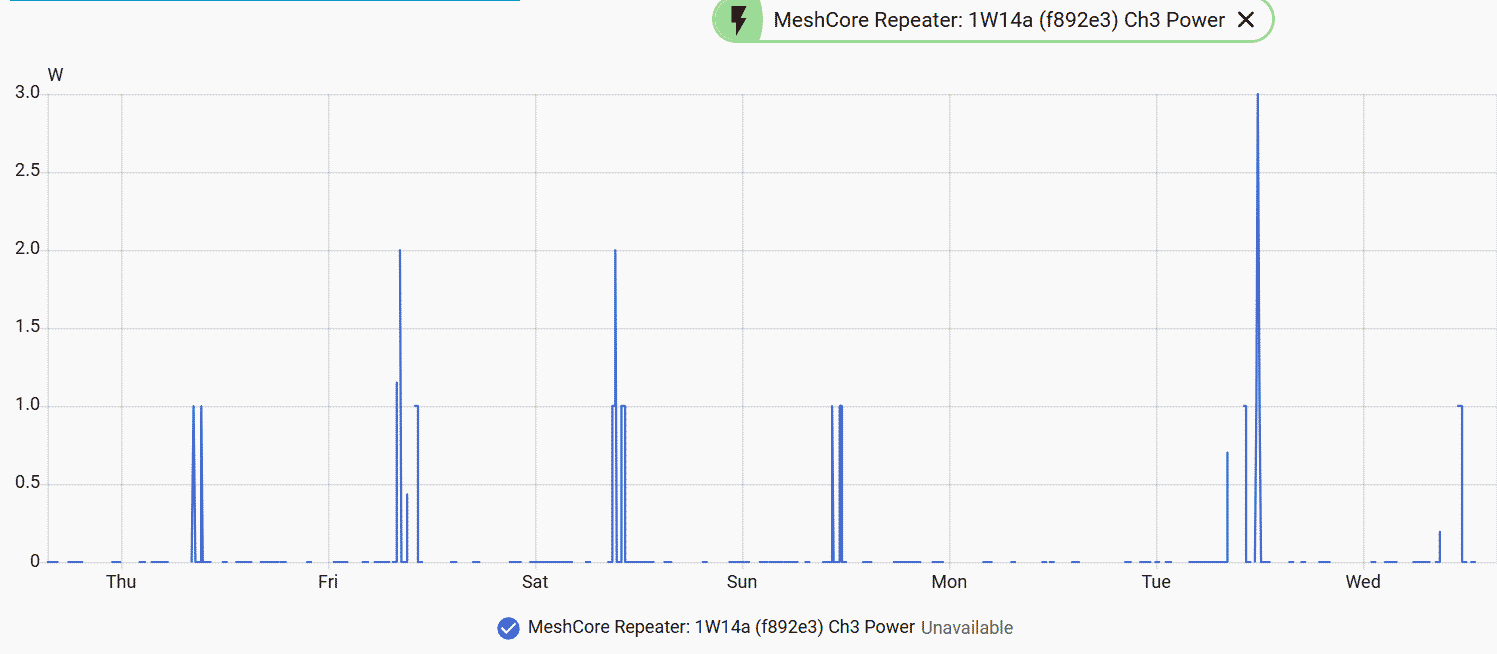
Now we can look at the power delivered by the solar panel, seen at right. Each morning the power reaches 1 watt or sometimes 2 watts and occasionally 3 watts. This lasts as long as is needed to charge up the LTO battery. It will be appreciated that a day might have eight or more hours of daylight, and that only an hour or so of charging seems to be needed to charge up the battery fully. So we seem to have a very generous margin of eight to one, or better, to deal with cloudy days.
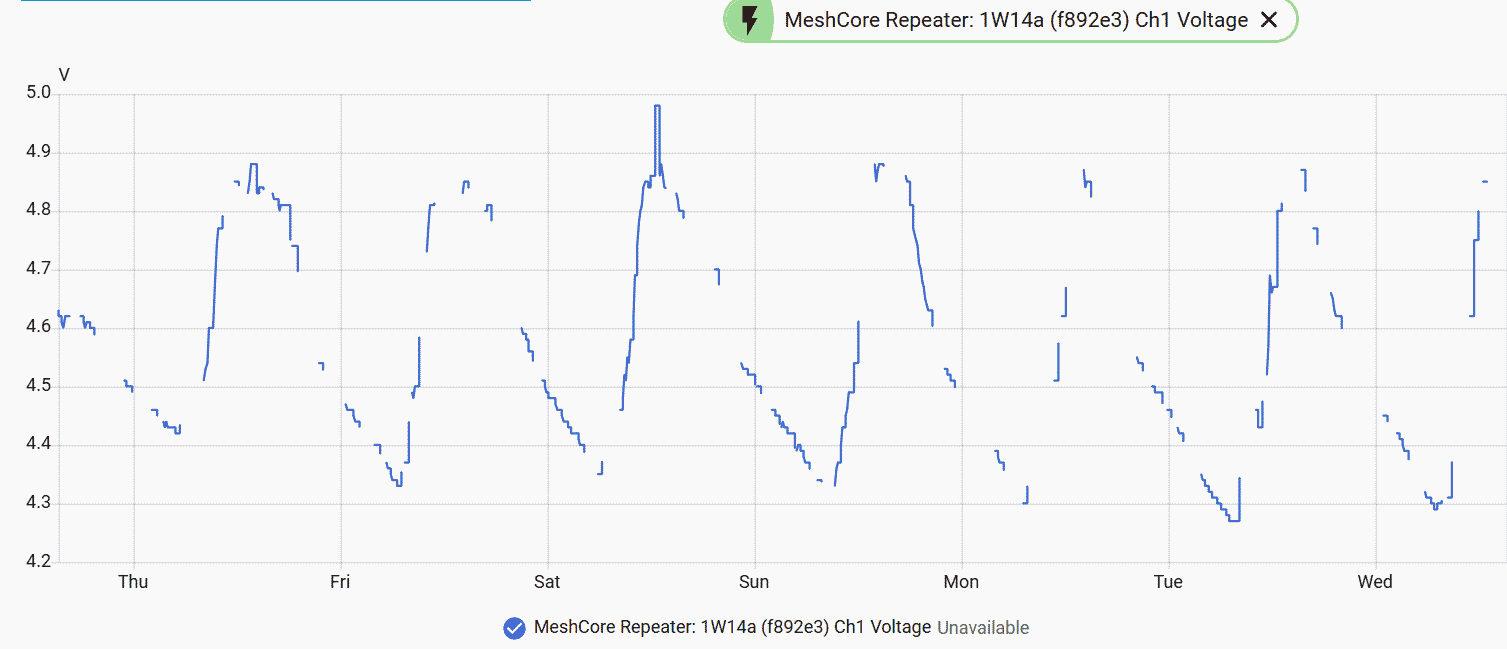
Finally we can look at the state-of-charge of the LTO battery, shown at right. Each day it gets charged up to around 4.9 volts, and then when the sun goes down the battery runs down during the night to around 4.3 volts. Then the sun comes up and it gets charged up again.
The data logs discussed above show seven days of charge-discharge activity. This permitted us to be confident that this particular newly constructed repeater can now be placed into service.
Leave a Reply