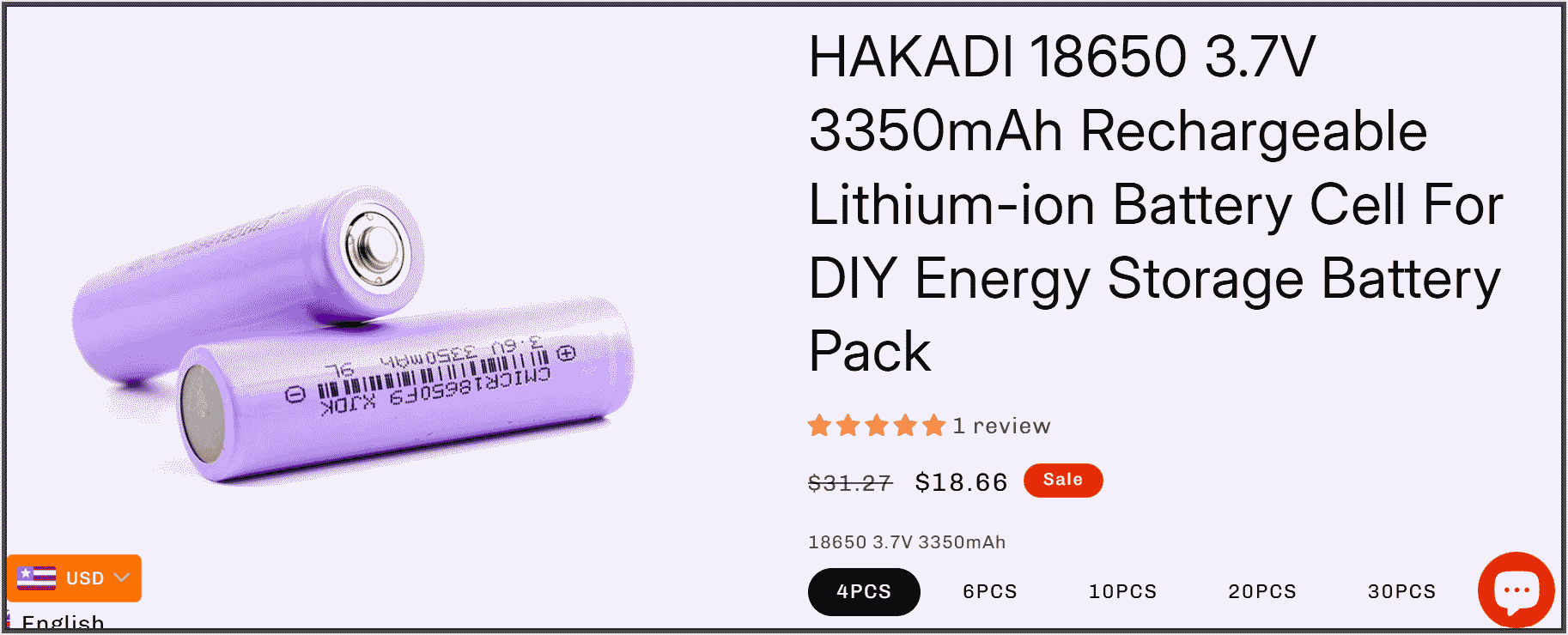
It’s no easy trick finding high quality lithium-ion 18650 batteries with high capacity at a reasonable price. I stumbled upon a company called Hakadi Battery Supermarket and was intrigued by the product listing quoted above. Was it really true that I could pay a mere $36 and receive ten 3350-mAh batteries?
The shopping cart listing showed button-top batteries, light purple in color, with a claimed charge capacity of 3350 mAh and a chemistry of 3.6V. My plan, of course, was to test the batteries upon arrival to see whether they perform as promised.
I placed an order on June 3, 2026, and was pleasantly surprised to see that the vendor applied a $5 discount. I was charged a mere $31 (and no shipping cost) for ten batteries. The batteries were shipped from Shenzhen and were delivered via USPS on June 13 (ten days later). Keep in mind that the de minimus customs exception that makes it easy and inexpensive for a foreign vendor to ship to the US via USPS has been gone for many months now. It means that a foreign vendor needs to go to some lengths nowadays to successfully fulfill an order for a US customer in a way that does not put the US customer at risk of having to pay an import tariff that is likely to cost more than the value of the merchandise.
So, yes, it was free shipping, and someone who’s not me had to deal with customs issues. So far as the USPS was concerned, my package got mailed in Jamaica, NY. Someone who’s not me somehow transported my package from Shenzhen to New York, dealt with customs, and handed the package over to the USPS in New York.
But I digress. Back to the batteries. What showed up was batteries with little resemblance to the shopping-cart listing. They were light blue in color, not light purple, and were branded “EVE” instead of “9L”. The batteries were labeled 3.5Ah (meaning 3500 mAh) rather than the advertised 3350 mAh and were labeled to have a 3.5V chemistry rather than the advertised 3.6V. From the point of view of my DIY projects, the biggest disappointment is that the batteries that showed up were flat-top, not the advertised button-top.
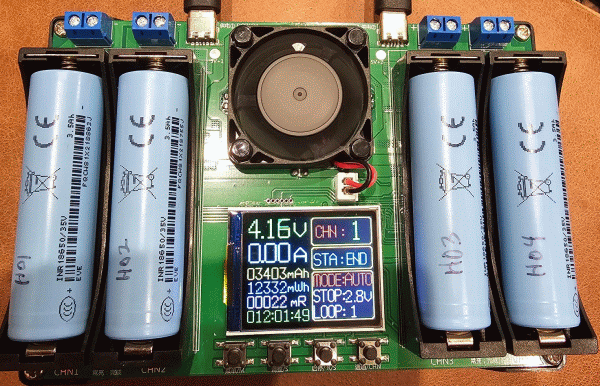
But I figured there was little choice but to test the batteries. Which I did. My tester runs at one ampere, so a 3.5-Ah battery takes around 3½ hours to discharge and at least another 3½ hours to recharge. A complete “auto” capacity testing cycle took 11 hours or more, as seen at right. Here are the results:
| serial number | charge capacity mAh |
energy capacity mWh |
mR |
| FQCW81X218863J | 3403 | 12332 | 22 |
| FQCW81X218755J | 3413 | 12383 | 19 |
| FQCW81X218864J | 3382 | 12230 | 22 |
| FQCW81X218860J | 3386 | 12273 | 23 |
| FQCW81X218838J | 3390 | 12270 | 23 |
| FQCW81X218837J | 3390 | 12285 | 21 |
| FQCW81X218836J | 3369 | 12210 | 29 |
| FQCW81X218862J | 3376 | 12216 | 25 |
| FQCW81X218756J | 3400 | 12330 | 20 |
| FQCW81X218861J | 3396 | 12310 | 20 |
A first important observation is that the internal-resistance numbers (“mR”) were all just fine.
A second important observation is that the shopping cart said “3350 mAh” and each of the ten batteries tested better than 3350 mAh. (But not one of the batteries satisfied its labeled capacity of 3500 mAh.)
Of course it is too soon to tell whether the batteries will turn out to be satisfactory. Will each battery provide, say, one thousand discharge-charge cycles while maintaining most of its capacity? I won’t know until after the one thousand cycles have taken place. Will the batteries provide their function over my likely range of ambient temperatures? I won’t know until a winter season has come and gone.
And will Hakadi send replacement batteries with button tops, since that is what I ordered and paid for?
I can’t explain logically why I feel this way, but my guess is that Hakadi will send replacement batteries with button tops, and that the replacements will also test well, and that the batteries will have a good service life and will function over my range of temperatures.