If all goes well, a Meshcore repeater will soon get deployed to Mount Baldy near Breckenridge. This posting describes some of the preparations for this imminent deployment.
The first repeater was installed on Baldy in 1955. It was a television repeater, receiving VHF television signals from the flatlands and retransmitting the signals into Summit County. There is an amateur radio repeater operating on Baldy, part of the Colorado Connection.
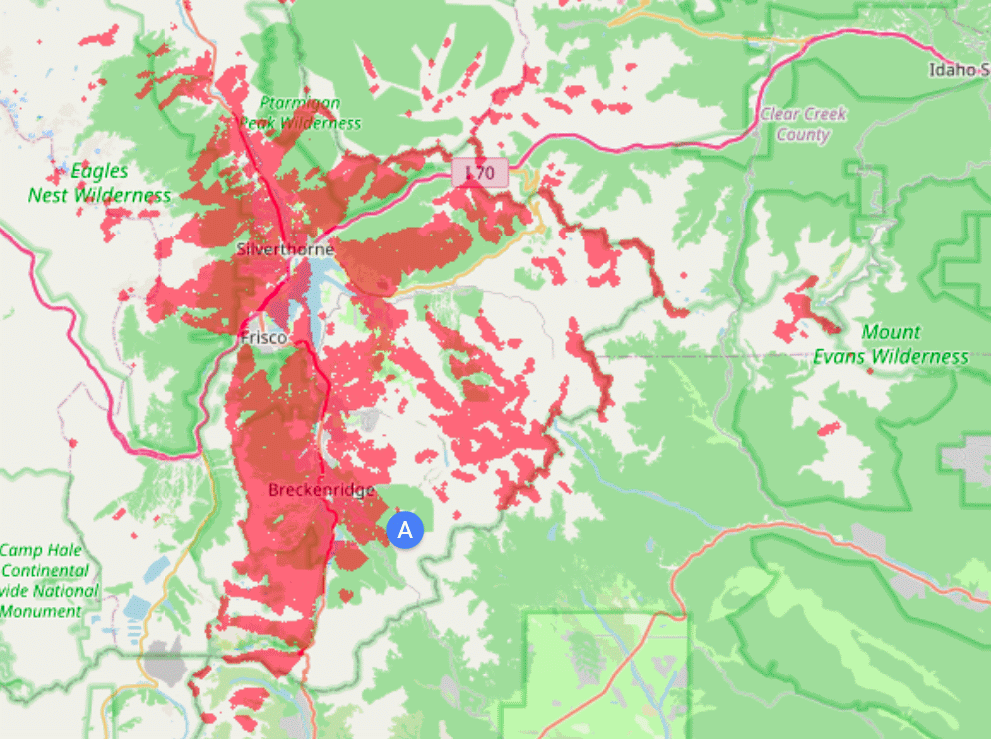
The Baldy location is very important because of its impressive coverage area, seen at right. The location covers much of Breckenridge and also reaches much of Silverthorne. But coverage also reaches many distant high points to the west, east, and north where a future repeater could dramatically expand Meshcore coverage.
Baldy is a demanding location from the point of view of repeater design and implementation. The location is inaccessible each year during many winter months. Frigid temperatures threaten the battery chemistry and high winds threaten the antenna. The thin air means that UV exposure is high and this threatens the antenna and its transmission line.
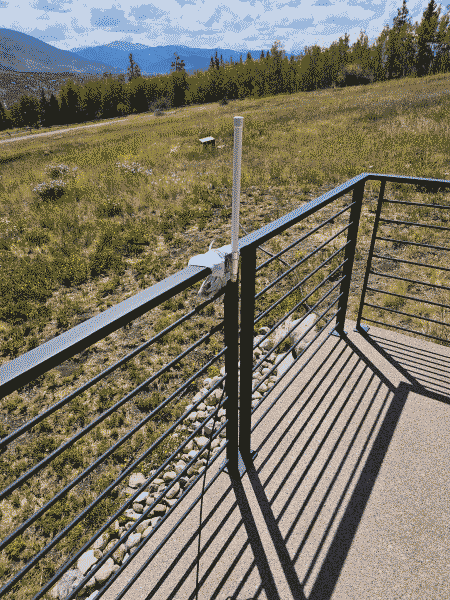
In the US, Meshcore operates in the 900-MHz ISM band, limited to transmit power of 30 dBm (one watt). This means that to communicate with distant repeaters, the repeater designer must try to minimize transmission-line losses, and must give a lot of thought to the selection of the antenna itself. Here our choice, seen in the photo above, is a fiberglass antenna with 5.8-decibel gain. (I believe the antenna is simply a straight thin wire inside the fiberglass tube.) The wavelength in this band is about 13 inches (about 33 cm) and the antenna is just this length.
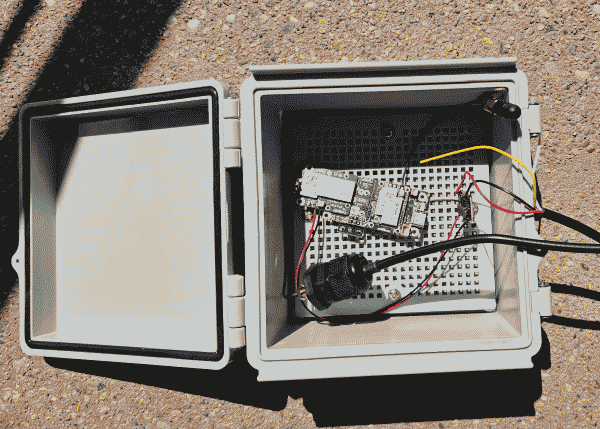
We have the luxury that others already went to the trouble and expense to provide a radio hut and solar panels and battery storage. Others will provide 12-volt power. (This radio will draw an average of about 72 mW (about 6 mA) at 12 volts, which is negligible when compared with other loads within the hut.) At right you can see a weatherproof plastic box which will be placed in the hut to hold the LoRa radio and voltage converter (12 volts to 5 volts).
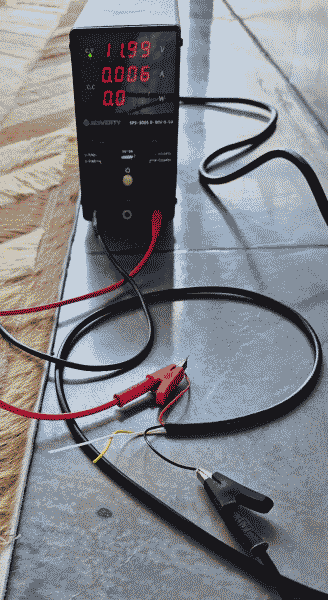
The equipment is being tested now to provide some measure of confidence that the repeater may perform reliably when deployed at Mount Baldy. The power supply shown at right is providing 12vdc to the repeater in this test setup.
In testing, the repeater is successfully achieving SNR values of 9 or better to nine repeaters, the farthest of which is around five miles (8 km) away.
Testing will continue for at least another day. Perhaps readers can communicate with this repeater, which is named EGE-BRECK-BALDY-RC-C282. Please post a comment below.
Leave a Reply