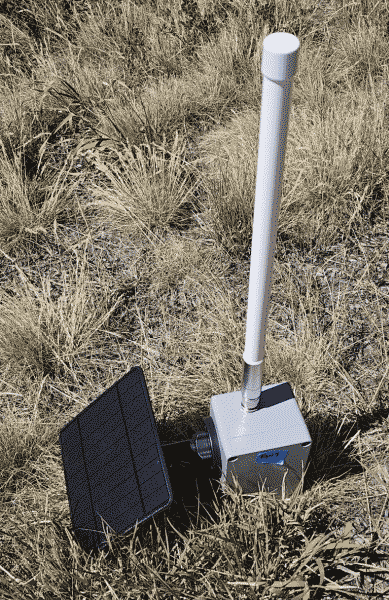
Newly constructed repeater 1W9, powered by yellow LTO cells branded Huahui New Energy, operating at 1W and using a full-wave antenna, is now in test.
Also in test is newly constructed repeater 1W10, powered by purple LTO cells branded Hakadi, which you can read about here.
The 1W9 repeater uses a RAK WisMesh 1W Booster Starter Kit which is SKU 116256. This is the “battery powered” variant for the US 915-MHz market. The solar panel is said to be 5 volts and 5 watts. The antenna is a fiberglass 915-MHz antenna with a male N-type connector.
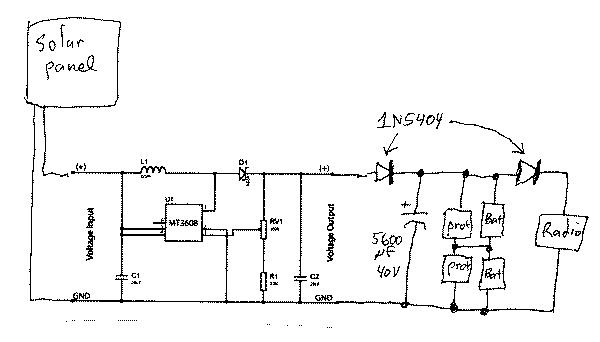
You can see a schematic at right. The solar panel is connected to the input of an MT3608 buck converter which hopefully has been set (using the potentiometer) to an output of 5.6 volts (measured after the first 1N5404 diode). The converter’s output passes through the 1N5404 diode that was just mentioned. You can see a 5600-μF 40V electrolytic capacitor across the output. The battery is composed of two LTO (lithium-titanate-oxide) cells.
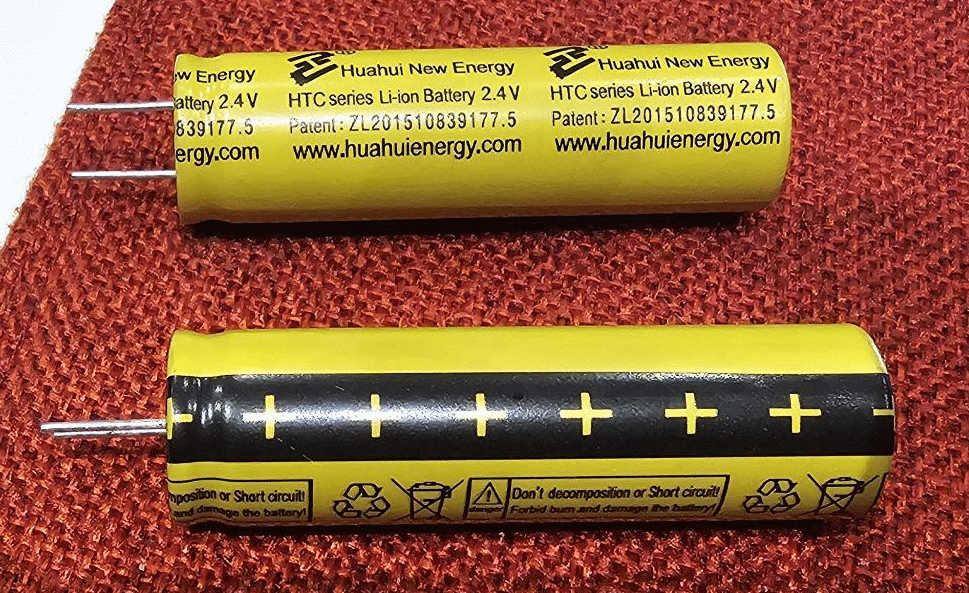
Each cell (seen at right) is an LTO 18650 cell with nominal voltage 2.4V and rated capacity 1300 mAh and 3.12 Wh (spec sheet). Each cell cost $14.44 from Battery Space (shopping cart page). The cells are denoted “bat” in the schematic above. The branding is Huahui New Energy.
Two cells were placed in series to form a battery with nominal voltage 4.8V. The battery is balanced with two sections of a six-section balancer (shopping cart page). The balancer sections are denoted “prot” in the schematic above.
The charging voltage might be 5.6V which is too high for the radio. (The power input of the radio is intended to be in a range of 1.8V to 5.5V.) So a second 1N5404 diode is used to cut the power supply by about 0.6V, to slightly under 5V.
It is important to recall that the battery connector on the radio is wired “backwards”, so a standard PH2 battery cable needs to be wired using black as positive and red as negative.
A Bosch BME280 sensor was added to the radio as described here. This uses the I2C bus of the RAK 19007 baseboard. It measures temperature, humidity and barometric pressure, made available to software at telemetry channel 2.
The repeater is housed in an aluminum weatherproof box (shopping cart page) that is 5.9 by 3.9 by 3.1 inches (150x100x80mm). Here is a list of all of the external penetrations:
- N-type bulkhead female connector on top (for LoRa antenna)
- SMA bulkhead male connector on bottom (for Bluetooth antenna)
- ¼-inch machine screw on bottom (for bracket mounting)
- two 3/16-inch holes on side (for mounting the solar panel)
- one ¼-inch hole on side (for entry of power cable from solar panel)
An effort was made to seal all penetrations with silicone caulk.
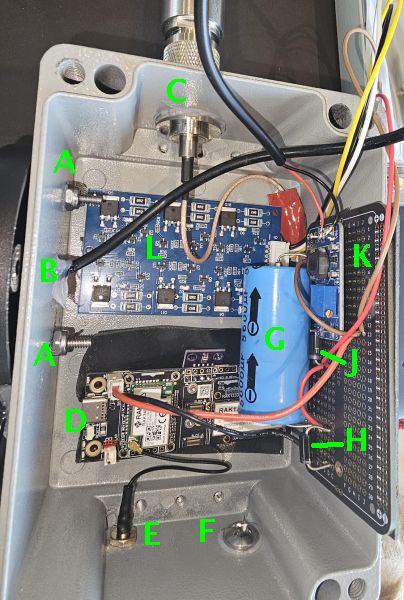
At right is a view of the interior of the case. We can see mounting bolts A securing the solar panel and entry point B for the power cable from the solar panel. We see the top-mounted N-type connector C for the LoRa antenna. The radio D is secured to the back wall with mounting tape and you can see the PH2 battery cable powering the radio. The Bluetooth connector E and mounting stud F are at bottom. The large electrolytic capacitor G may be seen, and first diode J and second diode H. The MT3608 buck converter K may be seen, and it is oriented so that the adjustment screw of its potentiometer can be reached if the cover is open.
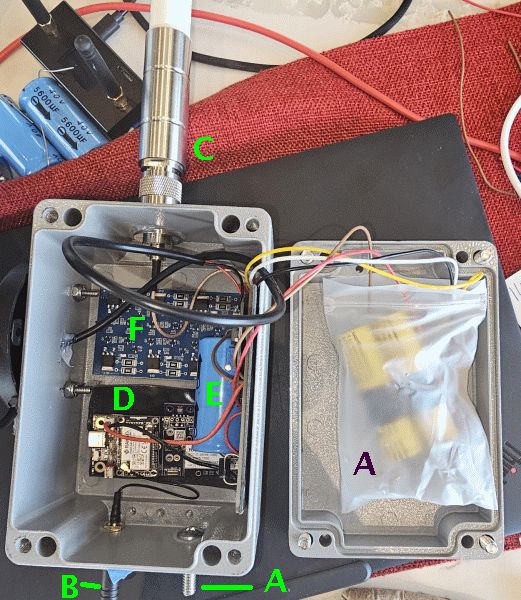
Here is another view of the interior of the repeater. The battery A (“black”) is in a bag that is mounted to the inside face of the cover. Bluetooth antenna B and mounting stud A (green) are seen at bottom. Fiberglass LoRa antenna C is seen at top. The radio D and balancer F are mounted to the rear wall of the box and and capacitor E may be seen mounted to the right wall of the box.
The radio was flashed with the 0.9.2-OTAFIX2.2-BP1.3 bootloader and v1.17.1-d929643 (Build: 14-Aug-2026) Meshcore repeater firmware. Its test name is 1W9 and the public key is 62824d2428b076140bb57b56b8d4310b85d78f8a0e29d71b313cc915d3bd9f67.
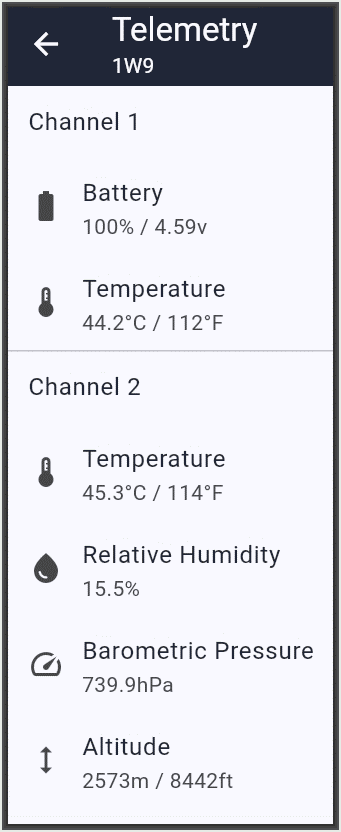
At right is a typical telemetry report with channel 2 providing the measurements from the Bosch BME280 sensor.
The antenna (shopping cart page) is said to have 5.8 dBi gain.
Here are some neighbors:
- Ruby Ranch – 11.75 dB
- Ptarmigan – 11.25 dB
- Riley – 11 dB
- Hamilton Creek – 11 dB
- Cottonwood – 10.75 dB
- Windy Point – 9.5 dB
- Baldy Yagi – 8dB
- Mount Royal – 6dB
- Tenderfoot – 5.75 dB
- Victoria – -1.5 dB
- Swan Mountain – -2 dB
The battery has a nominal capacity of perhaps 6.24 Wh. Given that the radio draws a quiescent 30 mW, one might expect the battery to last several days without sunlight. The LTO chemistry is said to work down to -40°.